Любопытная заметка на Conscientious:
On doubt
There was a moment in the Sally Mann documentary recommended here earlier that I found very striking: After having finished her series "What Remains", and after having agreed on getting the work shown at some very prestigious New York gallery, Sally Mann is being informed that the gallery decided to cancel the show. Of course, she is very upset about this (who wouldn't be?); and then while she's trying to understand what might possibly be the reason, I noticed that one obvious possible explanation is never brought up: Maybe the work simply isn't that good…
…I've always wondered how artists deal with doubt about their work. I often find that aspect way more interesting than any other aspect. In fact, I usually find people who have absolutely no doubt about what they're doing somewhat scary.
Of course, I don't know whether Sally Mann thought about this — the documentary never mentions it, and since she was very honest and open in it, one might use that as a clue.
…But I remember when I watched the documentary I was just struck by that aspect of artistic work missing - part of why is probably because I think that the photography that the documentary focuses on really is so much weaker than Sally Mann's earlier portraiture.
http://www.jmcolberg.com/weblog/2008/09 ... .html#more
*
Colin Pantall's blog: Sally Mann:
An excerpt from a question and answer session between Sally Mann and Stephen Cantor, director of What Remains — interesting what Sally Mann has to say about misconceptions about the responses to her work.
http://colinpantall.blogspot.com/2008/0 ... -mann.html
*
EDWYNN HOUK GALLERY is pleased to announce the opening of the SALLY MANN exhibition, LAST MEASURE, marking her first one-person show in New York since the highly lauded Deep South exhibition in 1999. It will feature 14 large scale works made from 8 by 10 inch collodion wet-plate glass negatives.
http://www.houkgallery.com/mann-lastmea ... asure.html
Deep South: http://www.houkgallery.com/mann-deepsouth/mann_1.html
A conversation with photographer Sally Mann about her book 'What Remains' and her early career as a writer.
http://discussion-for-you.com/video/1722.cgi
Sally Mann: What Remains, 2004:
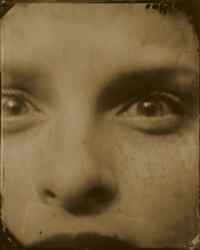
Sally Mann, Untitled #2, 2000,
from the series What Remains, ambrotype
"Death is powerful," says Mann…
…Untitled, perhaps the most visually shocking section in the exhibition, is made up of images of human bodies going through the natural process of decomposition at a forensic study site. In this series, Mann does not shield the viewer from the reality of bodily decay. "There's a moment where you look at those bodies and say, 'that was a human being.' That was someone who was loved, cherished, caressed," says Mann. "That's a very tough one for me, the whole question of when a human becomes remains. That question came up over and over again while I was doing this work." (right: Sally Mann, Untitled #2, 2000, from the series What Remains, ambrotype, lent by the artist, courtesy of Edwynn Houk Gallery, New York. Copyright © 2003 by Sally Mann)
The middle section of this exhibition features two series of landscape images: December 8, 2000 focuses on the site where an armed fugitive committed suicide on Mann's bucolic property in Virginia's rural Shenandoah Valley. She witnessed life meeting death at her doorstep and this transitional incident served as the raw inspiration from which her photographic project unfolded. The Antietam series of landscape photographs, made at the Antietam battlefield in Sharpsburg, Maryland, go far beyond simple documentation of this rural Civil War location where 23,000 men were killed, wounded or declared missing on a single day in September 1862. These large scale images invite the viewer to contemplate the role of photography in documenting history, time passing and death's sanctification of the eternal soil. In an editorial review of the accompanying book, regarding the Antietam series Reed Business Information, Inc. says "But in the book's most successful sequence -- depicting the Civil War battlefield of Antietam -- there are no literal traces of the dead at all, only an overwhelming psychic weight, which is reflected in intensely dark surfaces pocked with fissures and holes that at times resemble fields of stars laid over the barely visible hills, trees and fields."
Mann concludes the project with What Remains. thirty-six extreme close-up portraits of her three children's faces seen floating in an inky black atmosphere. While the subjects of these loving photographs appear in stark contrast to the ghostly images of death in her other series. the viewer cannot help but recall the other images when looking into the faces of the children. In this context, her children are "what remains."
http://www.tfaoi.com/aa/4aa/4aa339.htm
Все ссылки на одной странице, интервью, видео (включая процесс), презентации работ и т.п.:
http://www.pbs.org/art21/artists/mann/index.html
On doubt
There was a moment in the Sally Mann documentary recommended here earlier that I found very striking: After having finished her series "What Remains", and after having agreed on getting the work shown at some very prestigious New York gallery, Sally Mann is being informed that the gallery decided to cancel the show. Of course, she is very upset about this (who wouldn't be?); and then while she's trying to understand what might possibly be the reason, I noticed that one obvious possible explanation is never brought up: Maybe the work simply isn't that good…
…I've always wondered how artists deal with doubt about their work. I often find that aspect way more interesting than any other aspect. In fact, I usually find people who have absolutely no doubt about what they're doing somewhat scary.
Of course, I don't know whether Sally Mann thought about this — the documentary never mentions it, and since she was very honest and open in it, one might use that as a clue.
…But I remember when I watched the documentary I was just struck by that aspect of artistic work missing - part of why is probably because I think that the photography that the documentary focuses on really is so much weaker than Sally Mann's earlier portraiture.
http://www.jmcolberg.com/weblog/2008/09 ... .html#more
*
Colin Pantall's blog: Sally Mann:
An excerpt from a question and answer session between Sally Mann and Stephen Cantor, director of What Remains — interesting what Sally Mann has to say about misconceptions about the responses to her work.
http://colinpantall.blogspot.com/2008/0 ... -mann.html
*
EDWYNN HOUK GALLERY is pleased to announce the opening of the SALLY MANN exhibition, LAST MEASURE, marking her first one-person show in New York since the highly lauded Deep South exhibition in 1999. It will feature 14 large scale works made from 8 by 10 inch collodion wet-plate glass negatives.
http://www.houkgallery.com/mann-lastmea ... asure.html
Deep South: http://www.houkgallery.com/mann-deepsouth/mann_1.html
A conversation with photographer Sally Mann about her book 'What Remains' and her early career as a writer.
http://discussion-for-you.com/video/1722.cgi
Sally Mann: What Remains, 2004:
Sally Mann, Untitled #2, 2000,
from the series What Remains, ambrotype
"Death is powerful," says Mann…
…Untitled, perhaps the most visually shocking section in the exhibition, is made up of images of human bodies going through the natural process of decomposition at a forensic study site. In this series, Mann does not shield the viewer from the reality of bodily decay. "There's a moment where you look at those bodies and say, 'that was a human being.' That was someone who was loved, cherished, caressed," says Mann. "That's a very tough one for me, the whole question of when a human becomes remains. That question came up over and over again while I was doing this work." (right: Sally Mann, Untitled #2, 2000, from the series What Remains, ambrotype, lent by the artist, courtesy of Edwynn Houk Gallery, New York. Copyright © 2003 by Sally Mann)
The middle section of this exhibition features two series of landscape images: December 8, 2000 focuses on the site where an armed fugitive committed suicide on Mann's bucolic property in Virginia's rural Shenandoah Valley. She witnessed life meeting death at her doorstep and this transitional incident served as the raw inspiration from which her photographic project unfolded. The Antietam series of landscape photographs, made at the Antietam battlefield in Sharpsburg, Maryland, go far beyond simple documentation of this rural Civil War location where 23,000 men were killed, wounded or declared missing on a single day in September 1862. These large scale images invite the viewer to contemplate the role of photography in documenting history, time passing and death's sanctification of the eternal soil. In an editorial review of the accompanying book, regarding the Antietam series Reed Business Information, Inc. says "But in the book's most successful sequence -- depicting the Civil War battlefield of Antietam -- there are no literal traces of the dead at all, only an overwhelming psychic weight, which is reflected in intensely dark surfaces pocked with fissures and holes that at times resemble fields of stars laid over the barely visible hills, trees and fields."
Mann concludes the project with What Remains. thirty-six extreme close-up portraits of her three children's faces seen floating in an inky black atmosphere. While the subjects of these loving photographs appear in stark contrast to the ghostly images of death in her other series. the viewer cannot help but recall the other images when looking into the faces of the children. In this context, her children are "what remains."
http://www.tfaoi.com/aa/4aa/4aa339.htm
Все ссылки на одной странице, интервью, видео (включая процесс), презентации работ и т.п.:
http://www.pbs.org/art21/artists/mann/index.html


